

Built on Infrastructure as Code
Anyshift doesn’t just read your cloud. It reads your code, your state, and your live infrastructure, then correlates the three so you can see where they agree and where they’ve drifted.
See the graph
Annie can also draw the graph. Ask “map our cluster” or “diagram the dependencies of the payment service” and she renders the live topology from the knowledge graph as a diagram you can read at a glance.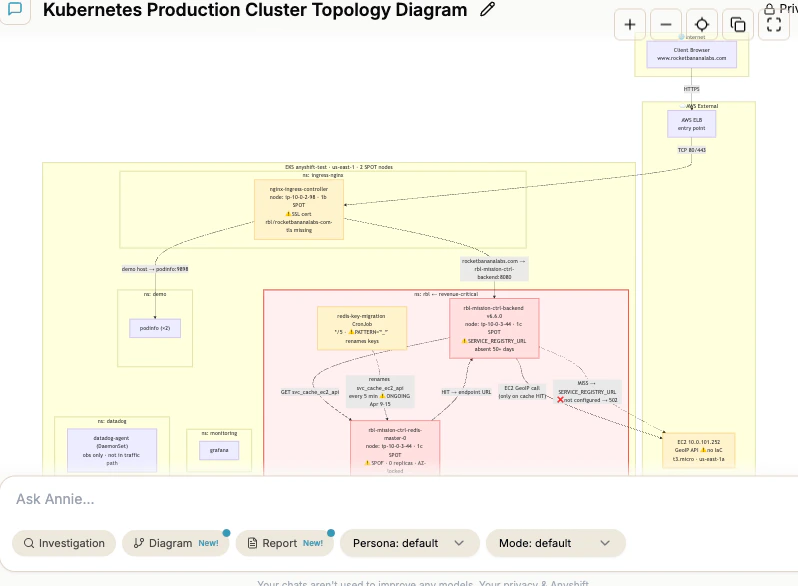
A live Kubernetes topology Annie drew from the knowledge graph: ingress, namespaces, workloads, and the cross-layer dependencies between them.
Working with diagrams
Explore
Zoom, pan, and open any diagram fullscreen to follow a dependency chain across layers.
Saved to your library
Every diagram lands in Artifacts → Diagrams, so you can reopen and share it later.
Standard Mermaid
Diagrams are plain Mermaid. Copy the source and paste it into GitHub, Notion, or any Mermaid-compatible tool.
From any surface
Ask for a diagram in a conversation, and dig deeper with a follow-up question right where you are.
What You Can Ask Annie
Code-to-infra questions
Code-to-infra questions
- “Which Terraform module created this EC2 instance?”
- “Show me all resources defined in the networking module”
- “What variables does this state file use?”
Drift detection
Drift detection
- “What resources were modified outside of Terraform this week?”
- “Which live resources have no Terraform backing?”
- “Are my declared replicas matching the pods actually running?”
Impact analysis
Impact analysis
- “What breaks if I destroy this module?”
- “Which services depend on this security group?”
- “If I change this variable, what resources are affected?”
Explore the IaC Section
Terraform
How Annie ingests Terraform code and state, and what she does with them.
Kubernetes (Live)
How Annie streams live cluster state and ties it to your declared K8s manifests.
Drift Detection
Find the gap between what you declared and what’s actually running.
Knowledge Graph
How all of this connects under the hood.